


| Sehmi Family |
|
|
|
|
ABINGDON
. ELDORET . GENEVA . NAIROBI . MELBOURNE . SANTA ROSA . TAJPUR
|
Colonel Vakil Singh
Sohal
(Maternal uncle of Naginer and Mohinder)
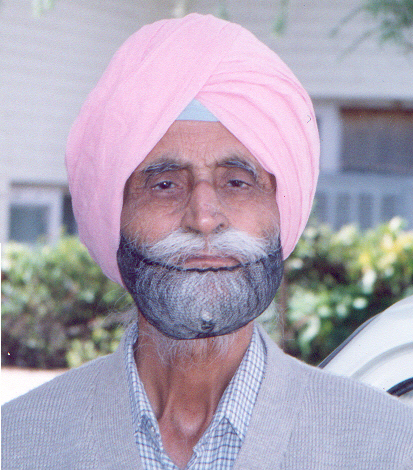
Col Vakil Singh Sohal passed away on 30 Nov 02 at Chandigarh at the age of eighty-one. He was the third generation of the four consecutive generations of his family that served in the Bengal Sappers. Having joined the King George's Military School at Jallandhar in 1932 he joined the Bengal Sappers on 14.5.1938 and was posted to 70 FD Coy which saw some of the severest fighting with the Japanese at Imphal. His performance was so good that he was immediately chosen to undergo training at the OTS Bangalore and was commissioned in the Bengal Sappers on 20 Jan 1945 and joined 69 FD Coy then fighting in Mesopotamia at Basra in Iraq, where he remained till the end of war. He was promoted out of turn as the OC and brought back to the unit to Shahjehanpur after the war. In wake of the partition his unit was immediately inducted in Jammu and Kashmir, and apart from carrying out several major tasks on Madhopur-Jammu- Akhnoor road, spearheaded the Sapper effort in the Rajaori-Punch link up. For his outstanding work he was awarded "Mention-in-despatches" in 1948. After the cessation of hostilities his unit was moved from J&K to Meghalaya for the maintenance of roads bordering East Pakistan. After completing his supplementary degree course, where he stood third in 1952, he was posted to 368 FD Coy (Maharaja Faridkot's own) at Ferozepore, but was moved to 26 INF Div in J&K to carryout some very tough engineer tasks. He then moved as chief instructor field works at Roorkee for a short time and then as S02 to CE WC till 1960. On promotion as a Lt. Col. he raised 9 Border Road Task Force and did pioneering work in the construction of road from Kargil to Leh in some of the worst weather conditions and with equipment that was unsuitable for high altitude and extreme cold weather. But with his leadership and ingenuity he achieved the impossible. In March 1963 he was posted as DY COMT of the Centre but only after a year he moved to yet another executive assignment as CWE Ambala where during the 1965 war he kept the runway functional in spite of frequent bombing raids. He was then sent on deputation as CE (Civil Engg) at the HAL MIG Factory at Koraput where he stayed till he was promoted and posted as Dy CE North Zone at Lukhnow and from where he retired in 1971. However he was immediately appointed as CE (Civil) at HAL Bangalore for the helicopter factory and stayed there till 31 Dec 1974. Col. Sohal was an outstanding officer who was totally committed to his Job; indeed work was worship for him. Because of his total commitment and honest approach he was highly respected by officers and men of the corps particularly the Bengal sappers. A deeply religious man he preached and practised the tenets of Sikh religion in true substance. A true follower of Sant Ishar Singh (Clairanwale) of Nanaksar he not only paid obeisance there every month but transcribed his teachings from audio tapes in the form of four books - the fifth volume is under print and distributed these at cost price. He used to visit Hazoor Sahib at Nanded every year and even this year when his health did not permit he did not relent m went all the way m Nanded whereafter he caught this respiratory affliction that proved fatal. His wife survives him and three sons two of whom were in the army and retired as colonels and the third is a senior executive in Mico-Bosch at Bangalore. He was a model life of a perfect soldier and a true Sikh. An unrivalled beacon of virtue even in today's world untouched and affected by any worldly temptation. We have indeed lost not only a great colleague and friend but also a great soul from, our midst.
An important part of his military life is described in a unique account in "BURMA 1942: THE JAPANESE INVASION" by Ian Lyall Grant and Kazuo Tamayama with foreword by Field Marshal Lord Carver (The Zampi Press, Chichester, UK. Jan. 1999; 400 pages) This frank account of Britain's desperate attempt to defend Burma in 1942 is unique, for it is a combination of deep research from both sides. It throws an entirely new light on the extraordinary story of this little-known campaign. The co-authors describe clearly why Burma was so important to the Japanese, and why the British failed to foresee their attack. Churchill did not realise the great strategic importance of Burma until after the Japanese war had started. The brilliant Japanese invasion, using novel and unexpected tactics, forced the small multi-racial British force, outclassed by its opponents, into a stubborn retreat, the longest in British history. The extraordinary features of the many battles; the bitterly defended road-blocks; the savage close-quarter fighting; the ferocious night-attacks in the forest; the gruelling marches; the blazing heat; the help of our Chinese allies; the plight of the refugees; the mistakes, the disasters and the heroism; all make an amazing and dramatic story. General Wavell said of his troops that, in the circumstances they put up a remarkable performance and showed a fine fighting spirit." Greatly helped by the bold handling of their tanks, the British blocked repeated Japanese attempts to annihilate them, and marched back to India as veterans. The lessons they had learned the hard way would be used to achieve Burma's re-conquest two years later.
|